Choosing the right feeding method for buffaloes is a critical decision for any farmer. It directly impacts the health of your animals, the quality and quantity of their milk, and your farm’s overall profitability. In Nepal, where buffalo farming is a cornerstone of the rural economy, this choice between traditional grazing and modern manual feeding (stall-feeding) is more relevant than ever.
This post will explore the effects of grazing versus manual feeding on buffaloes. We will compare these two methods across several key areas: animal health, milk production, cost-effectiveness, and environmental sustainability. Enhanced with practical tables, case studies from Nepal, and research-backed insights, this guide aims to help you make the best decision for your herd.
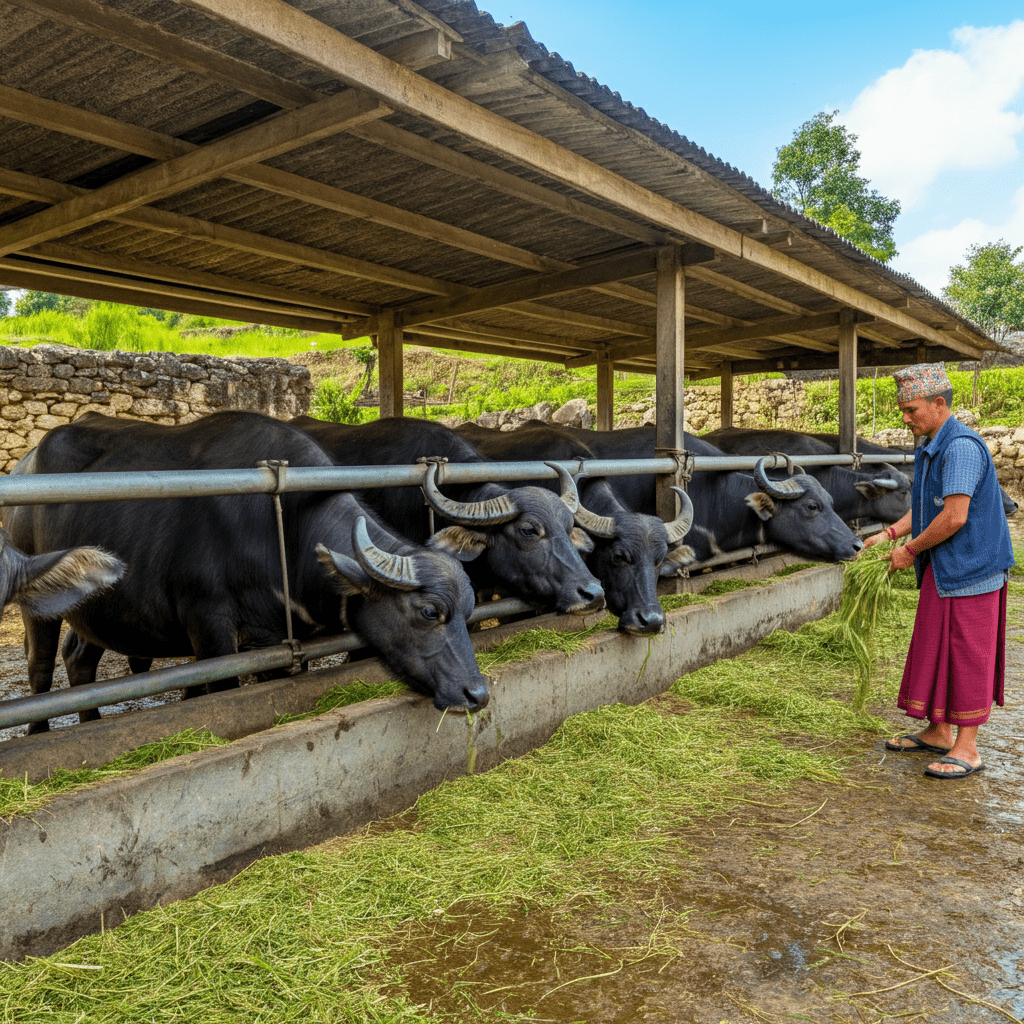
Grazing allows buffaloes to roam pastures and forage for their own food, mimicking their natural behaviors. Manual feeding, or the “cut-and-carry” system, involves keeping buffaloes in a stall where farmers bring them pre-cut fodder, concentrates, and water. Both systems have distinct advantages and disadvantages that every farmer should understand.
An animal’s health is the foundation of a productive farm. The feeding system you choose plays a massive role in their physical and mental well-being.
When buffaloes graze, they engage in natural behaviors like walking, socializing, and selecting their own plants. This physical activity is excellent for their health. It helps prevent common issues like lameness and metabolic disorders by strengthening their muscles and joints. Exposure to sunlight also allows them to synthesize Vitamin D, which is essential for calcium absorption and bone health.
Furthermore, a varied diet from a well-managed pasture can provide a wide range of nutrients that might be missing from a uniform, manually-fed diet. This natural foraging can lead to a more robust immune system and greater overall resilience.
Manual feeding offers unparalleled control over a buffalo’s diet. You can create a precisely balanced ration to meet the specific nutritional needs of each animal, whether they are lactating, pregnant, or growing. This is especially important for high-yielding breeds that require more energy and protein than pasture alone can provide.
Stall-feeding also protects buffaloes from predators, adverse weather conditions, and exposure to certain parasites or toxic plants found in open fields. It makes it easier to monitor individual animals for signs of illness, allowing for quicker intervention and treatment.
A farmer in a rural part of Ilam, with access to eight hectares of community pastureland, transitioned his herd of 15 buffaloes to a managed rotational grazing system. Within a year, he reported a 40% reduction in his annual feed costs. While his total milk volume saw a slight dip in the dry season, the milk quality improved, fetching a 15% higher price at the local cooperative due to its richer cream content. His veterinary bills also decreased, as instances of hoof problems and digestive issues dropped significantly.
For most dairy farmers, milk yield is the ultimate measure of success. Both feeding methods can produce good results, but they influence milk output in different ways.
Grazing buffaloes expend energy walking around, which can sometimes mean less energy is available for milk production. The nutritional quality of pasture also fluctuates with the seasons, leading to inconsistencies in milk yield. During dry seasons or in areas with poor-quality grass, milk production can drop significantly if not supplemented.
However, research shows that milk from grass-fed animals often contains higher levels of beneficial fatty acids, like Omega-3 and Conjugated Linoleic Acid (CLA). This can make the milk more nutritious and command a premium price from health-conscious consumers.
Manual feeding is often the preferred method for maximizing milk production. By providing a consistent, high-energy diet, farmers can push their buffaloes to their genetic potential for milk yield. You can easily supplement their feed with concentrates, minerals, and vitamins to ensure they receive everything they need for optimal lactation. This controlled environment removes the variables of pasture availability and quality, resulting in a more predictable and often higher volume of milk.
| Parameter | Grazing Buffaloes | Manually Fed Buffaloes |
|---|---|---|
| Milk Nutrients | Higher levels of Omega-3 & CLA. | Standard nutrient profile. |
| Vitamin Synthesis | Natural Vitamin D from sun exposure. | Requires Vitamin D supplements. |
| Diet Consistency | Varies by season and pasture quality. | Consistent, balanced year-round. |
| Energy Balance | More energy spent on movement. | Energy is conserved for milk production. |
A commercial dairy operation near Banepa, Kavre, manages a herd of 50 high-yielding Murrah-cross buffaloes on just two acres of land. Using a stall-fed system, they provide a total mixed ration (TMR) of maize silage, rice bran, and commercial concentrates. This precision feeding allows them to achieve an average of 10-12 liters of milk per buffalo daily, far exceeding the regional average. While their feed costs are high, the consistent, high-volume output makes their business highly profitable and a key milk supplier for dairy processors in the Kathmandu Valley.
Running a farm is a business, and managing costs is essential for profitability. Grazing and manual feeding have very different financial implications.
The most significant advantage of grazing is its low cost. If you have access to sufficient pasture land, your feed costs are drastically reduced. You save money on labor for cutting and transporting fodder, as well as on purchasing expensive concentrates. The main cost associated with grazing is land. In densely populated areas of Nepal, owning or leasing enough land to support a herd can be prohibitively expensive.
Manual feeding is more intensive in terms of labor and cost. You must invest time and effort daily to cut, collect, and distribute fodder. You will also have higher expenses for purchasing supplementary feeds and concentrates. However, this system requires far less land. You can raise a significant number of buffaloes on a small plot, making it a viable option for farmers with limited acreage.
| Cost Factor | Grazing System | Manual Feeding System |
|---|---|---|
| Land Requirement | High (e.g., 0.5-1 acre per buffalo) | Low (can be zero-grazing) |
| Feed Costs | Low to Moderate | High |
| Labor Costs | Low (for herding) | High (for cutting, carrying feed) |
| Infrastructure | Minimal (fencing) | High (sheds, troughs) |
| Profit Potential | Lower but stable returns. | High potential but higher risk. |
Modern farming must also consider its long-term impact on the environment.
Well-managed rotational grazing can be beneficial for the environment. As buffaloes graze, their manure naturally fertilizes the soil, improving its fertility. This can enhance biodiversity and reduce the need for chemical fertilizers. Grazing systems also help sequester carbon in the soil. The risk lies in overgrazing, which can strip land of vegetation and lead to soil erosion.
Manual feeding allows for efficient management of manure. In a stall-fed system, manure can be easily collected and composted to create high-quality organic fertilizer (“gobar”), which many farmers in Nepal use or sell. On the downside, growing fodder crops can be resource-intensive, requiring significant water and land.
A farming cooperative in Chitwan has adopted a hybrid model for their 100+ buffaloes. The animals graze on communal grasslands during the morning. In the afternoon, they are brought into a central shed where they receive supplementary feed consisting of crop residues and a formulated concentrate. This approach allows them to reduce feed costs while still ensuring the animals receive enough energy to maintain high milk production. The system has become a model for sustainable intensification in the region, balancing cost, animal welfare, and productivity.
So, which method is best? The answer depends on your specific circumstances.
Ultimately, the best approach is one that fits your resources, goals, and local conditions. By carefully weighing the pros and cons of grazing and manual feeding, you can create a system that ensures your buffaloes are healthy, productive, and profitable for years to come.