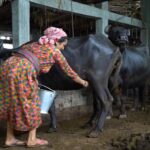
Comprehensive cost analysis of Murrah buffaloes in Nepal. Explore price categories, regional trends, factors influencing cost, subsidies, ROI and practical advice for farmers. Data accurate as April 2026 based on market research.
| Key Point | Insight |
|---|---|
| High milk yield | Murrah buffaloes are renowned for high milk production; standard animals yield 6–8 L/day and superior cows produce 12–15+ L/day, far exceeding local buffaloes (4–6 L/day). |
| Price range | Average prices range from 1.6–4.5 lakh NPR depending on milk yield and pedigree; champion bloodlines can exceed 5 lakh NPR. |
| Government support | Farmers benefit from 80 % livestock insurance subsidies, up to 50 % grants under the buffalo and cattle promotion programme and AI programmes introducing unsexed Murrah semen. |
| ROI | A standard Murrah buffalo producing around 12 L/day yields monthly income of about 43,000 NPR when milk sells at around 120 NPR/L. Profit margins remain attractive after feed costs and allow farmers to recoup their investment within a few years. |
| Suitable environment | Murrah buffaloes thrive in warm, lowland climates; a failed programme in Karnali showed that the breed struggles in cold, hilly regions and requires warm, dry sheds and ample fodder. |
Murrah buffaloes (Bubalus bubalis) are prized dairy animals originally from Haryana and Punjab, India. They have been introduced to Nepal through government breeding programmes and private farms because of their superior milk yield, rich fat content and strong genetic traits. Official data from Nepal’s National Livestock Breeding Office (NLBO) show that a nucleus herd of about 60 pure Murrah cows is maintained in Pokhara, producing 64 calves and distributing 16 breeding bulls to farmers in one fiscal year. Mature Murrah cows weigh about 430–500 kg and bulls around 530–575 kg, making them larger and more muscular than local breeds.
The breed’s productivity is remarkable: average lactation yields range from 1,500–2,500 kg per lactation and field studies report daily yields of 6–8 litres for standard cows, 8–12 litres for superior cows and up to 15 litres for exceptional animals. The milk contains about 7–8 % fat, which is ideal for ghee and cheese. With proper management, Murrah buffaloes can calve every 12–15 months and remain productive for more than 10 years, providing a long‑term return on investment.
Demand for Murrah buffaloes in Nepal has grown rapidly in recent years. Farmers seek them for higher milk yield and improved income, while cooperatives and development programmes promote the breed to uplift rural livelihoods. The NLBO and provincial governments import or breed bulls and distribute semen to upgrade local buffalo genetics. In fiscal year 2079/80, NLBO produced 64 calves and supplied 16 breeding bulls to various parts of the country. India has also gifted high‑quality Murrah bulls valued at around 2–2.2 million NPR each; cross‑breeding with local buffaloes can triple milk production.
Commercial farms illustrate the potential profitability: a women’s cooperative under the World Bank’s Rural Enterprise and Economic Development (REED) project invested around 189,000 NPR to purchase Murrah buffaloes with a matching grant and expected significant increases in daily milk output. Other farmers in Rolpa reported that market access and REED’s grants enabling the purchase of Murrah buffaloes producing 5–6 L of milk and technical guidance improved household income.
However, the success of Murrah buffalo farming depends heavily on environment and management. Investigative reports on the Karnali Province’s Rs 340 million dairy promotion programme reveal that imported Murrah buffaloes struggled in the cold hill regions; many died or failed to conceive, and farmers sold them cheaply. Experts explained that the breed is suited to the Terai’s warm, dry climate and needs proper sheds and feeding. This underscores the importance of matching the animal to the environment and not over‑extending into unsuitable areas.
Murrah buffalo prices vary by age, milk production, genetics and pregnancy status. The table below summarises typical 2026 price ranges based on market research and industry guides.
| Type | Approximate milk yield | Price range (NPR) |
|---|---|---|
| Heifer (not yet calved) | first lactation | 1,60,000 – 2,20,000 |
| Pregnant cow | calf expected within months | 2,20,000 – 3,00,000 |
| Commercial cow | 12–15 L/day | 2,10,000 – 2,75,000 |
| High‑milk premium | 16–22 L/day | 2,80,000 – 4,50,000 |
| Champion bloodline | proven genetics & high yield | 3,00,000 – 5,00,000+ |
The table shows that basic heifers suitable for first‑time farmers can be obtained around 1.6 lakh NPR, while high‑yielding or champion animals command prices above 4 lakh NPR. Commercial cows producing around 12–15 litres per day, which suit most dairy operations, generally cost between 2.1–2.75 lakh NPR.
Several factors influence Murrah buffalo prices beyond simple supply and demand:
Prices differ across Nepal depending on market infrastructure and supply. Though exact figures fluctuate daily, general trends are observable:
| Region | Price trend | Notes |
|---|---|---|
| Chitwan | Premium quality and higher prices | A major dairy hub; strong demand encourages farmers to invest in high‑yield buffaloes; buyers expect well‑bred animals. |
| Nawalpur/Rupandehi | Moderate prices | Moderate supply and good transport links keep prices stable. |
| Bara/Parsa (including Nepalgunj) | Lower price, high supply | Buffaloes are imported from India and traded in bulk; abundant supply keeps prices lower. |
| Itahari (Sunsari) | Stable market | Prices are relatively steady because of balanced supply and demand. |
| Pokhara | High demand | A growing dairy industry and limited local supply push prices upward. |
These trends suggest that farmers in premium markets like Chitwan and Pokhara may pay slightly more for quality animals but can also command higher milk prices, while those near border towns such as Nepalgunj may obtain buffaloes more cheaply due to supply from India.
The Nepali government and development partners offer several forms of support for Murrah buffalo farming:
Insurance subsidy: Under the livestock insurance programme, the government reimburses 80 % of premiums for policies up to 5 million NPR, 65 % for policies worth 5–10 million and 50 % for policies above 10 million. This reduces farmers’ risk of loss due to disease or accidents.
Buffalo and cattle promotion grant: In November 2025 the Ministry of Agriculture and Livestock Development launched a programme to boost meat export. The operational guidelines provide up to 50 % grant subsidy for purchasing calves, improving livestock sheds, cultivating fodder and procuring equipment. Farmers must apply through their local government and buy animals from approved breeding centres.
Dairy promotion schemes: Past initiatives like Karnali’s dairy promotion programme provided grants of around 75,000 NPR per Murrah buffalo, but a lack of climate suitability led to high mortality and poor productivity. This highlights the need to invest subsidies wisely, ensuring animals are kept in appropriate environments.
Artificial insemination and breeding programmes: NLBO maintains a nucleus herd of Murrah buffaloes and distributes breeding bulls and semen across the country. The Enhanced Rural AI (TERAI) project introduces sexed Jersey cattle semen and unsexed Murrah semen to improve genetics in Rupandehi and Kapilvastu districts. India also gifts high‑value Murrah bulls to Nepal, supporting genetic improvement.
Community grants: World Bank’s REED project provides matching grants that allow cooperatives to purchase Murrah buffaloes and receive training. Farmers in Rolpa reported that grants enabled them to buy buffaloes producing 5–6 L/day and boosted milk income. Other beneficiaries invested around 189,000 NPR and expected significant increases in daily output.
Purchasing a quality Murrah buffalo is a substantial investment, but several financing avenues can ease the burden:
Farmers should prepare a business plan, estimate feed and housing costs and approach financial institutions early. Insuring livestock protects against unexpected losses.
The price varies by class. Standard cows producing 8–11 L of milk per day cost about 1.6–2 lakh NPR, commercial animals yielding 12–15 L/day cost 2.1–2.75 lakh NPR and premium cows with 16–22 L/day can cost 2.8–4.5 lakh NPR. Champion bloodlines or animals with exceptional records may exceed 5 lakh NPR.
Field data indicate that local buffaloes produce around 4–6 litres of milk per day, whereas Murrah buffaloes produce 6–12 litres, with top performers reaching 15 litres or more. The high fat content (around 7–8 %) makes the milk valuable for dairy products.
No. Investigations into Karnali’s Murrah programme showed that the breed could not adapt to cold, steep terrain; many animals died or failed to conceive. Murrah buffaloes require warm, dry sheds and ample fodder, conditions more common in the Terai plains.
Farmers can receive an 80 % subsidy on livestock insurance premiums for policies up to 5 million NPR, tapering down to 50 % for policies above 10 million. The buffalo and cattle promotion programme offers up to 50 % grants for buying animals, improving sheds, cultivating fodder and purchasing equipment. REED and other development projects provide matching grants and technical training.
Look for animals with good body condition, regular lactation records and strong genetic traits. Check the milk yield and stage of lactation, ensure the cow is vaccinated and free of diseases, verify breed purity and avoid overpaying for animals with low production or health issues. If possible, consult veterinarians or experienced farmers before purchase.
Murrah buffaloes offer a compelling opportunity for Nepalese farmers seeking higher dairy productivity and long‑term profitability. Their exceptional milk yield, high fat content and long productive lifespan make them attractive investments. Market prices range from around 1.6 lakh NPR for young heifers to more than 5 lakh NPR for champion bloodlines. Government support programmes provide substantial insurance subsidies and grants that reduce financial risk, while artificial insemination initiatives and development projects strengthen breeding and management.
Success depends on selecting healthy animals, providing balanced nutrition, ensuring warm and dry housing and matching the breed to a suitable climate. The failure of the Karnali programme serves as a cautionary tale: Murrah buffaloes thrive in warm lowland regions but struggle in cold hill districts. Farmers who follow best practices and leverage available subsidies can achieve impressive returns, helping Nepal’s dairy sector grow and improving rural livelihoods