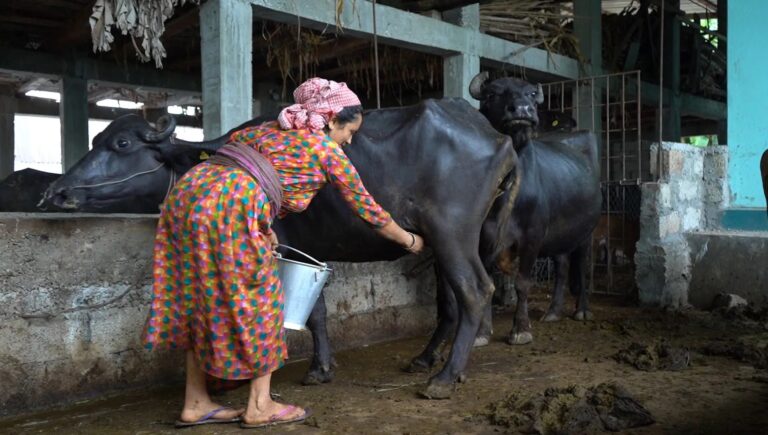
Buffaloes are the backbone of Nepalese livestock farming. They supply more than half of the country’s milk and around one‑third of its meat production, and they provide draft power, manure and cultural value in rural communities. While the imported Murrah breed and its crosses dominate commercial dairies, most smallholders still rely on hardy indigenous buffaloes that are well adapted to Nepal’s diverse geography. Understanding the characteristics, distribution and performance of these native breeds is essential for sustainable farming and conservation programmes.
| Insight | Information |
|---|---|
| Four indigenous breeds identified | Nepal recognises four indigenous buffalo breeds: Lime, Parkote and Gaddi are long‑standing hill breeds, and the Terai buffalo is a recently identified riverine breed. |
| Distribution & share | Lime and Parkote buffaloes together account for roughly 58 % of the national buffalo population and are widely distributed in the western hills. |
| Milk production | Average daily milk yields: Lime ≈3 L, Parkote ≈2.77 L, Gaddi ≈3.5 L; the newly identified Terai buffalo yields around 1.6 L/day. |
| Size differences | Gaddi buffaloes are the largest indigenous breed with an average adult weight of about 452 kg, whereas Lime buffaloes are the smallest at around 311 kg. |
| Adaptation & resilience | Indigenous buffaloes thrive from 1 500 to 4 500 m elevation and can survive under harsh conditions with minimal external inputs. |
Research identifies four indigenous buffalo breeds in Nepal. Three of them—Lime, Parkote and Gaddi—are long‑recognised hill buffaloes, and a fourth, the Terai buffalo, has recently been documented in the eastern plains. Each breed has unique features and a specific geographical range:
Lime and Parkote buffaloes populate the hills and river basins of western Nepal. Lime animals inhabit low to mid hills and foothills, often at elevations above 1 500 m where temperatures range from –2 °C in winter to 25–33 °C in summer. Parkote buffaloes occur in similar elevations across the western hills and mid‑hill river valleys. Together, Lime and Parkote buffaloes constitute over half of the national buffalo population.
Gaddi buffaloes are concentrated in the far‑western mid to high hills at elevations from 1 500 m to 4 500 m where the climate can be cool and rainfall ranges from 860 to 1 242 mm. The Terai buffalo, on the other hand, is found in the eastern Terai plains at elevations around 800–1 200 m, with annual rainfall between 2 000 and 2 500 mm. This distribution reflects the adaptability of indigenous buffaloes to diverse agro‑ecological zones.
Indigenous buffaloes generally have lower milk yields than exotic breeds. They are dual‑purpose animals valued for milk and meat. Average daily milk yields range from about 2 L to 3.5 L in Lime, Parkote and Gaddi buffaloes and about 1.6 L in the Terai buffalo. The standard lactation length is around 305 days for Lime and Parkote, 420 days for Gaddi and 285 days for Terai buffaloes. Milk fat content in Lime and Parkote buffaloes ranges from 6.5 % to 7.5 %, giving their milk a rich flavour and high butter value.
Gaddi buffaloes are known as the best milkers among the indigenous breeds. A study found that Gaddi buffaloes averaged 3.5 L of milk per day with a range of 2.5–5.5 L and lactation lengths from 14 to 22 months. In contrast, Terai buffaloes produce less than 1 L/day even at peak lactation. Though their milk yields are modest compared with Murrah crossbreeds (which can produce 1 500 L per lactation), indigenous buffaloes are hardy and require minimal inputs.
Indigenous buffaloes contribute to household food security and local economies. They supply milk, meat and dung for manure, provide draft power for ploughing and pack transport, and support leather industries with their hides. Buffalo meat, known as cara‑beef, is popular among communities such as the Newar and is considered a healthier alternative to beef due to lower fat and higher protein.
These animals also play roles in social and religious practices. Male buffaloes are sacrificed during festivals and ceremonies, particularly in the Kathmandu Valley, and the breeds hold cultural value among various ethnic groups. Their ability to thrive in rugged terrain makes them indispensable for farmers in the hills and mountains.
Crossbreeding with imported Murrah bulls has increased milk production but has also diminished the pure indigenous population. Lime and Parkote buffaloes together still make up a majority of the national buffalo herd, yet pure forms of Parkote and Gaddi are declining because farmers cross them with Lime or Murrah to boost yields. The pure Parkote population is estimated at only 25 % of the indigenous hill buffalo population.
Government programmes aim to conserve indigenous breeds while improving productivity. Efforts include establishing buffalo genetic improvement programmes, distributing community breeding bulls, promoting artificial insemination and conserving purebred lines. Conservation plans also involve awareness campaigns, training farmers, and maintaining breed registries to prevent further erosion of genetic diversity.
| Parameter | Lime | Parkote | Gaddi | Terai |
|---|---|---|---|---|
| Average body weight (kg) | ≈311 | ≈342 | ≈452 | ≈331 |
| Height at withers (cm) | ~118.6 | ~124.1 | ~131 | ~132.4 |
| Body length (cm) | ~125 | ~127.7 | ~141 | ~128.5 |
| Average milk yield (L/day) | 3.0 | 2.77 | 3.5 | 1.6 |
| Lactation length (days) | 305 | 305 | 420 | 285 |
What are the indigenous buffalo breeds of Nepal? There are four recognised breeds: Lime, Parkote, Gaddi and Terai.
Which indigenous breed produces the most milk? Gaddi buffaloes have the highest average milk yield among the indigenous breeds, around 3.5 litres per day.
Where do Lime and Parkote buffaloes live? Lime buffaloes inhabit low to mid hills and river basins in western Nepal, while Parkote buffaloes thrive in mid hills and river valleys.
Are Terai buffaloes only used for meat? Terai buffaloes are primarily kept for meat because their milk yield is low—less than one litre per day.
Why is conservation important? Indigenous buffaloes are adapted to Nepal’s harsh environments and provide valuable genetic resources for future breeding programmes. Loss of purebred populations through crossbreeding threatens this diversity.
Indigenous buffalo breeds are an integral part of Nepal’s agricultural heritage. Lime, Parkote, Gaddi and Terai buffaloes have evolved to thrive in diverse climates, from cool high hills to warm plains. Their moderate milk yields, high fat content and dual‑purpose nature make them indispensable for smallholders, while their cultural roles reinforce their social importance. Conservation and improvement programmes must balance the desire for higher productivity with the need to preserve the unique genetics of these hardy animals. By understanding and valuing each breed’s characteristics, Nepal can ensure that its indigenous buffaloes continue to contribute to rural livelihoods and national food security for generations to come.