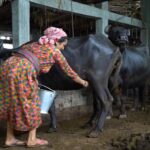
Buffaloes are the lifeblood of Nepal’s livestock sector. They contribute more than half of the country’s milk and a large share of meat production, providing draft power, organic manure and cultural value in rural communities. From the fertile Terai plains to the rugged mid-hills and highlands, buffaloes are woven into daily life. Choosing the right breed has a direct impact on farm productivity, profitability and sustainability. This guide explores the key buffalo breeds found in Nepal both indigenous and introduced to help farmers make informed decisions.
| Insight | Information |
|---|---|
| Five major buffalo breeds | Nepal’s farmers raise five key buffalo breeds: Murrah (imported for dairy) and four indigenous breeds—Lime, Parkote, Gaddi and the newly identified Terai buffalo. |
| Population share | The two hill breeds Lime and Parkote together constitute about 58 % of the national buffalo population. |
| Milk yields | Gaddi buffaloes produce about 3.5 L/day, Lime around 3 L/day, Parkote roughly 2.8 L/day and Terai around 1.6 L/day. Murrah buffaloes yield 10‑16 L/day and sometimes up to 20 L under excellent management. |
| Size differences | Gaddi buffaloes are the largest indigenous breed (average adult weight ~452 kg), while Lime buffaloes are the smallest (~311 kg). |
| Adaptation & resilience | Indigenous buffaloes thrive across elevations from 1 500 to 4 500 m and can survive harsh conditions with minimal external inputs, whereas Murrah buffaloes require intensive feeding and do best in warmer plains. |
This guide provides a detailed, research-backed look at the common buffalo breeds in Nepal, helping you make an informed choice that best suits your farm’s goals. We will explore the unique characteristics of breeds like Murrah, Lime, and Parkote. By understanding their specific traits, adaptability, and economic contributions, you can optimize your livestock investment.
uffaloes in Nepal fall into two broad categories: imported dairy breeds and indigenous breeds. The Murrah buffalo, imported from India, has become a commercial dairy mainstay due to its high milk yield. Indigenous breeds (Lime, Parkote, Gaddi and Terai) evolved in the hills and plains of Nepal; they are valued for their hardiness, adaptability and multipurpose use. The Terai breed is a recent addition recognised for its distinct physical traits and meat-oriented production.
Origin & traits: The Murrah breed originates from Haryana, India. It is uniformly black with tightly curled horns and a robust build. Murrah buffaloes are calm and well suited for stall-feeding systems.
Milk production: Under typical farm conditions, a Murrah buffalo yields 10‑16 litres of milk per day; with excellent feeding and care, yields can reach 18–25 litres. The milk contains about 7–8.5 % fat, making it ideal for ghee and paneer.
Adaptation: Murrah buffaloes thrive in warmer climates such as the Terai plains. They are sensitive to cold and require proper shelter in chilly regions. High-yielding animals need nutrient-rich fodder and regular veterinary care.
Pros and cons:
Best for: Commercial dairies and farmers in the Terai or valleys who can provide quality feed and infrastructure.
Origin & traits: The Lime buffalo is indigenous to the western and central mid-hills of Nepal. It has a grey to whitish-brown coat with white eyebrows and a chevron of lighter hair under the jaw and brisket. Its horns are small and sickle-shaped. As the smallest indigenous breed, the Lime has an average adult weight around 311 kg.
Milk production: Lime buffaloes produce about 3 litres of milk per day over a 305-day lactation. The milk has high fat content, making it suitable for household dairy products.
Adaptation: Highly adapted to steep, rugged terrain and temperature variations in the mid-hills. Lime buffaloes are semi-wild in temperament and can forage on low-quality vegetation.
Pros and cons:
Best for: Subsistence farmers in the mid-hills seeking a resilient animal that thrives on natural grazing.
Origin & traits: Parkote buffaloes are native to mid-hill river valleys across western Nepal. They have black or dark brown coats, sometimes with lighter shades on the legs, and distinctive sword-shaped horns. The average adult weight is about 342 kg.
Milk production: Parkote buffaloes produce roughly 2.8 litres of milk per day over a 305-day lactation.
Adaptation: Like the Lime, Parkote buffaloes are well adapted to hilly environments and can tolerate a wide range of temperatures. They are semi-wild but relatively docile compared with Lime.
Pros and cons:
Best for: Mid-hill farmers who need a hardy, low-maintenance animal for home consumption and manure.
Origin & traits: The Gaddi buffalo is found in the far-western mid and high hills of Nepal at elevations up to 4 500 m. It has a black coat with a white round patch on the forehead and long curved horns. Gaddi buffaloes are the largest indigenous breed with an average adult weight around 452 kg.
Milk production: They produce about 3.5 litres of milk per day and have a long lactation period of around 420 days. This makes them the highest milk yielders among the indigenous breeds.
Adaptation: Gaddi buffaloes are highly adapted to cold, steep regions and can subsist on coarse forage. They are docile and easy to handle.
Pros and cons:
Best for: Farmers in the high hills who want a docile, productive animal for milk and draft power.
Origin & traits: Recognised recently, the Terai buffalo inhabits the eastern plains at altitudes around 800‑1 200 m. It has a black coat with a white tail switch and pigmented skin. Terai buffaloes have fixed horns and a smaller body size relative to Gaddi but larger than Lime.
Milk production: Terai buffaloes are considered meat breeds; they produce about 1.6 litres of milk per day even at peak lactation.
Adaptation: They thrive in the hot, humid Terai plains with abundant forage and high rainfall.
Pros and cons:
Best for: Meat-oriented production systems and households in the Terai region who value meat and draft power over milk.
Selecting a buffalo breed depends on your farm’s location, resources and goals. Consider:
Buffaloes underpin Nepal’s agrarian economy. They supply more than half of national milk output and a substantial share of meat, with buffalo meat being the most consumed red meat in the country. Buffaloes provide organic manure that enriches soil and reduce dependency on chemical fertilisers. Their draft power is still essential in terraced fields where tractors cannot manoeuvre. Culturally, buffaloes feature in religious rituals and festivals; they symbolise strength and prosperity. Investing in the right breed supports household food security and preserves indigenous genetic resources.
| Breed | Milk yield (L/day) | Terrain & climate | Feed input | Primary use | Key notes |
|---|---|---|---|---|---|
| Murrah | 10‑16 (up to 25 with excellent management) | Warm plains (Terai, valleys) | High (concentrates & fodder) | Commercial dairy | High milk output; sensitive to cold |
| Lime | ~3 | Mid-hills (1 500 m+), steep slopes | Low (grazing & crop residues) | Household milk, draft power | Smallest breed; hardy, semi-wild |
| Parkote | ~2.8 | Mid-hills & river valleys | Low | Household milk, manure | Medium size; sword horns; docile |
| Gaddi | ~3.5 | High hills (up to 4 500 m) | Medium | Milk, draft, manure | Largest indigenous breed; docile |
| Terai | ~1.6 | Eastern Terai plains | Medium | Meat, draft | Newly recognised; low milk yield |
Murrah buffaloes can thrive anywhere. While Murrahs produce high milk yields, they are sensitive to cold and require warm environments and intensive care. They are not suited to high-altitude hills where indigenous breeds excel.
Indigenous buffaloes are unproductive. Indigenous breeds may have lower milk yields, but they provide draft power, manure and meat, thrive on low-quality feed and are crucial for the resilience of hill farming systems.
Crossbreeding always improves productivity. Crossbreeding Murrahs with indigenous breeds can improve milk yield, but it may also reduce hardiness and adaptability. Farmers need to balance productivity gains with the risk of losing local traits.
Buffaloes are partners in prosperity for Nepali farmers. Understanding the unique strengths and limitations of each breed—from the high-yielding Murrah to the hardy Lime and Parkote, the docile Gaddi and the newly recognised Terai—helps you choose animals that match your environment and goals. Whether you operate a commercial dairy in the Terai or a family farm in the hills, selecting the right breed and managing it wisely can enhance productivity, resilience and cultural heritage.
Before diving into specific breeds, it’s important to appreciate the multifaceted role buffaloes play. They are often called the “black gold” of Nepal for good reason. Economically, they are the primary source of milk, contributing over 70% of the country’s total milk production. Buffalo milk, with its high-fat content, is preferred for making traditional dairy products like ghee, paneer, and curd (dahi).
Beyond dairy, buffalo meat, locally known as “buff,” is the most widely consumed meat in the country, making livestock a key component of national food security. Their manure also serves as a valuable organic fertilizer, enriching soil and reducing the need for chemical inputs. Culturally, buffaloes hold a special place in religious ceremonies and festivals, symbolizing prosperity and strength.
Selecting the right breed requires balancing climate, terrain, feeding resources, and production goals. Let’s explore the key breeds that Nepali farmers rely on, comparing them across critical factors.
The Murrah is arguably the most famous dairy buffalo breed and has found a second home in Nepal’s commercial farming sector.
The Lime is an indigenous breed, perfectly sculpted by generations of adaptation to Nepal’s challenging mid-hills.
Similar to the Lime, the Parkote is another indigenous breed that demonstrates incredible resilience and adaptability.
| Feature | Murrah | Lime | Parkote |
|---|---|---|---|
| Milk Yield | High (8-16 L/day) | Low (2-4 L/day) | Low (2-4 L/day) |
| Best Terrain | Plains (Terai) | Mid-Hills | Mid-Hills |
| Input Cost | High | Low | Low |
| Adaptability | Moderate | High | High |
| Primary Use | Commercial Dairy | Subsistence Farming | Subsistence Farming |
| Common Problem | Needs quality feed | Low milk volume | Low milk volume |
The “best” buffalo breed does not exist in a vacuum; it depends entirely on your context. Here’s a simple guide to help you decide:
Which breed should I choose for a high-altitude farm? Choose the Gaddi or Lime breeds; they are adapted to high elevations and rugged terrain.
Is Murrah the only choice for commercial dairies? Murrah is the most popular commercial breed because of its milk yield, but some farmers successfully use high-yield Murrah crossbreds for better adaptability.
How do indigenous breeds contribute to sustainability? Indigenous buffaloes require minimal external inputs, improve soil through manure and withstand local diseases and climate extremes, supporting sustainable farming.
Can Terai buffaloes be used for dairy? Terai buffaloes are primarily meat animals; their milk yield is too low for commercial dairy purposes.
What feed is best for Murrah buffaloes? Provide balanced rations with green fodder, concentrates, minerals and clean water; consult extension services for specific feed formulations.