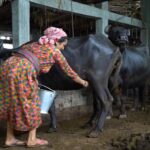
For farmers in Nepal looking to enhance their dairy operations, selecting the right livestock is the most critical decision. While many buffalo breeds can contribute to a farm’s success, one stands out for its exceptional productivity, resilience, and economic value: the Murrah buffalo. Originating from India, this world-renowned breed is often called the “black gold” of the dairy industry for good reason.
This article will explore the distinct advantages of choosing Murrah buffaloes over other breeds. We will cover their impressive milk yield, remarkable adaptability, and superior feed efficiency. By understanding their unique pedigree and genetic traits, you can see why investing in Murrah buffaloes is a strategic move for a more profitable and sustainable farming future.
The Murrah buffalo’s superiority is rooted in its strong genetic heritage. Understanding its origin and physical characteristics helps explain why it is such a prized asset for dairy farmers.
The Murrah breed originates from the Rohtak, Hisar, and Jind districts of Haryana, India, as well as the Punjab region. The name “Murrah” itself means “coiled” or “curled” in the local dialect, referring to the breed’s distinctively tight, curled horns. For centuries, farmers in this region have selectively bred these animals for high milk production and robust health, creating a genetically superior dairy buffalo.
You can easily identify a purebred Murrah buffalo by its unique features:
These physical traits are not just for show; they are the outward signs of a buffalo genetically engineered for dairy excellence.
The single most compelling reason to choose Murrah buffaloes is their incredible milk yield. While local buffalo breeds in Nepal might produce 3-5 liters of milk per day, a well-cared-for Murrah can easily produce 15-20 liters daily, with some exceptional individuals yielding even more. This high volume of milk directly translates to higher daily income for farmers.
Beyond quantity, the quality of Murrah milk is also superior. It has a high butterfat content, typically ranging from 7% to 9%, which is significantly higher than most cow breeds and many other buffalo breeds. This rich, creamy milk is perfect for producing high-value products like ghee, paneer (cottage cheese), and khoya, which command premium prices in the market. More milk and higher fat content mean more revenue streams and greater profitability.
Farming conditions can be challenging, with fluctuating weather and varying availability of resources. The Murrah buffalo’s remarkable adaptability makes it a reliable choice for diverse environments, including the varied climates of Nepal, from the Terai plains to the mid-hills.
Murrahs are known for their hardiness and excellent resistance to common diseases. Their strong constitution means they are less susceptible to illnesses that can plague other breeds, resulting in lower veterinary costs and fewer losses. They also have a calm and docile temperament, making them easier to manage and handle, which is a significant benefit for small-scale and family-run farms.
Every farmer knows that feed is one of the biggest operational costs. This is where the Murrah buffalo demonstrates its economic efficiency. They possess a superior feed-to-milk conversion ratio, meaning they can convert forage and feed into milk more effectively than many other breeds.
Even on a diet of standard grasses, crop residues, and agricultural by-products, Murrahs can maintain high milk production. While their output can be maximized with quality concentrate feed, their ability to thrive on locally available resources makes them a cost-effective option. This efficiency reduces the overall cost of milk production, allowing farmers to increase their profit margins without spending a fortune on expensive commercial feeds.
Investing in Murrah buffaloes is an investment in your farm’s financial future. The economic advantages are clear and cumulative.
Choosing the right breed is a foundational decision for any dairy farmer. The Murrah buffalo, with its distinguished pedigree, exceptional milk yield, and economic efficiency, offers a clear advantage over many other breeds. Their genetic traits, honed over centuries of selective breeding, make them a robust, productive, and profitable choice for the hardworking farmers of Nepal.
One notable mark of the Murrah’s global reputation is the booming market for its semen. Murrah buffalo semen is in high demand worldwide as farmers seek to import these superior genetics to improve herd productivity, milk yield, and adaptability in diverse environments. The economic value of high-quality Murrah semen is significant—prime bulls command premium prices, and their genetics are viewed as a smart investment for long-term farm gains. Governments, particularly in India, are investing in upgrading semen banks to respond to rising domestic and international demand, making improved Murrah genetics more accessible to farmers both locally and abroad.
Scientific research has also demonstrated that the quality of Murrah buffalo semen increases with the bull’s age and body weight, ensuring reliable results and healthy, productive offspring. For Nepali farmers, access to Murrah semen means the opportunity to expand and upgrade their herds without large up-front costs, further strengthening the breed’s impact on farm profitability and resilience.
By investing in Murrah buffaloes—or choosing their superior genetics through AI programs—you are not just buying an animal; you are embracing a legacy of dairy excellence. You are equipping your farm with a resilient and high-performing asset that can secure your financial well-being and contribute to a more prosperous agricultural community for generations to come.